> ## Documentation Index
> Fetch the complete documentation index at: https://docs.rulebase.co/llms.txt
> Use this file to discover all available pages before exploring further.
# Use Instruct
> Ask Rulebase questions about your own QA and support data, then keep, expand, and share the answers it builds.
Instruct is the chat inside Rulebase that can read your workspace. Ask it which
issues drove the most tickets last month, have it pull a ticket apart and explain
what the agent missed, or point it at a policy document and ask what your team is
supposed to do. It answers by querying your own data rather than guessing, and
when the answer needs more than a paragraph it builds something you can open
and send to someone else.
## Before you start
Instruct is granted per role, and it is not on for everyone by default:
administrators have it, and every other role needs it added. If your sidebar has
no **Chats** section and no **Instruct** button sits in the page header, that is
what you are missing: an admin can grant the **Instruct** permissions to your
role under
[Settings > People > Roles](https://app.rulebase.co/settings/people/roles).
Instruct reads what has already synced into Rulebase, so a workspace in its
first week will tell you it could not find something rather than inventing a
number.
## Start a chat, from anywhere
There are two ways in.
**A full chat page**, from **New chat** at the bottom of the **Chats** section in
the sidebar. Use it for analysis you expect to come back to, or want to send to
someone.
**An overlay**, from the **Instruct** button in the page header or
Cmd+J (Ctrl+J on Windows) anywhere in
the app. Esc tucks it away. The overlay opens on top of the screen you
were reading and takes that screen with it, so on a ticket, a dashboard, or a
scorecard you can ask "what went wrong on this one?" without naming it.
Either way, type the question the way you would ask a colleague. Working out
which tickets, evaluations, or records to read is Instruct's job, not yours.
## Point it at something specific
Type `@` in the composer to search your workspace and drop a real record into
the message. Tickets, teammates, agents on your roster, customers, companies,
onboarding cases, and knowledge base documents all resolve this way, and a
mentioned record means Instruct reads the ticket you meant instead of searching
for one that matches your description.
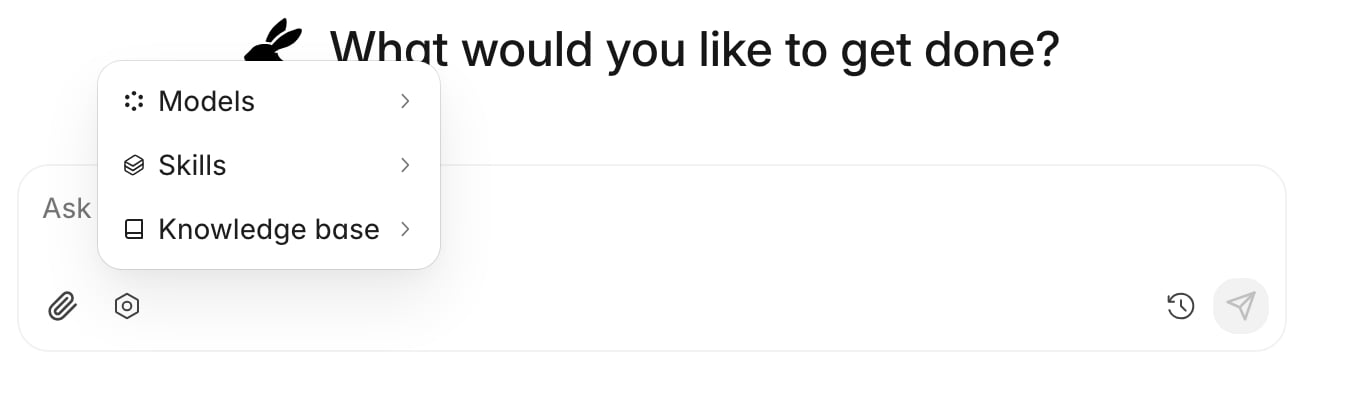
The settings icon beside the paperclip opens three more choices:
* **Models** — which model answers. Leave it on the default unless you have a
reason to change it.
* **Skills** — a saved set of instructions for a recurring job. Attaching one
tells Instruct how your team wants that job done.
* **Knowledge base** — a specific document to read, for when the answer should
come from your own policy rather than from ticket data.
 If an answer comes back close but not right, reply in the same chat rather than
starting over. Everything already established in the thread still applies, so
"split that by team" or "only the last 30 days" is a short follow-up instead of a
rebuilt question.
## Work with what it builds
Above each answer sits a line like *Ran 4 commands, retrieved 2 schemas, ran 7
queries*. Expand it when a number looks wrong and you get the actual queries.
When the answer deserves a layout rather than a paragraph, Instruct builds a
**canvas**: a small interactive view rendered from your data, with headline
figures, tables, and rows you can click into for the tickets behind them.
If an answer comes back close but not right, reply in the same chat rather than
starting over. Everything already established in the thread still applies, so
"split that by team" or "only the last 30 days" is a short follow-up instead of a
rebuilt question.
## Work with what it builds
Above each answer sits a line like *Ran 4 commands, retrieved 2 schemas, ran 7
queries*. Expand it when a number looks wrong and you get the actual queries.
When the answer deserves a layout rather than a paragraph, Instruct builds a
**canvas**: a small interactive view rendered from your data, with headline
figures, tables, and rows you can click into for the tickets behind them.
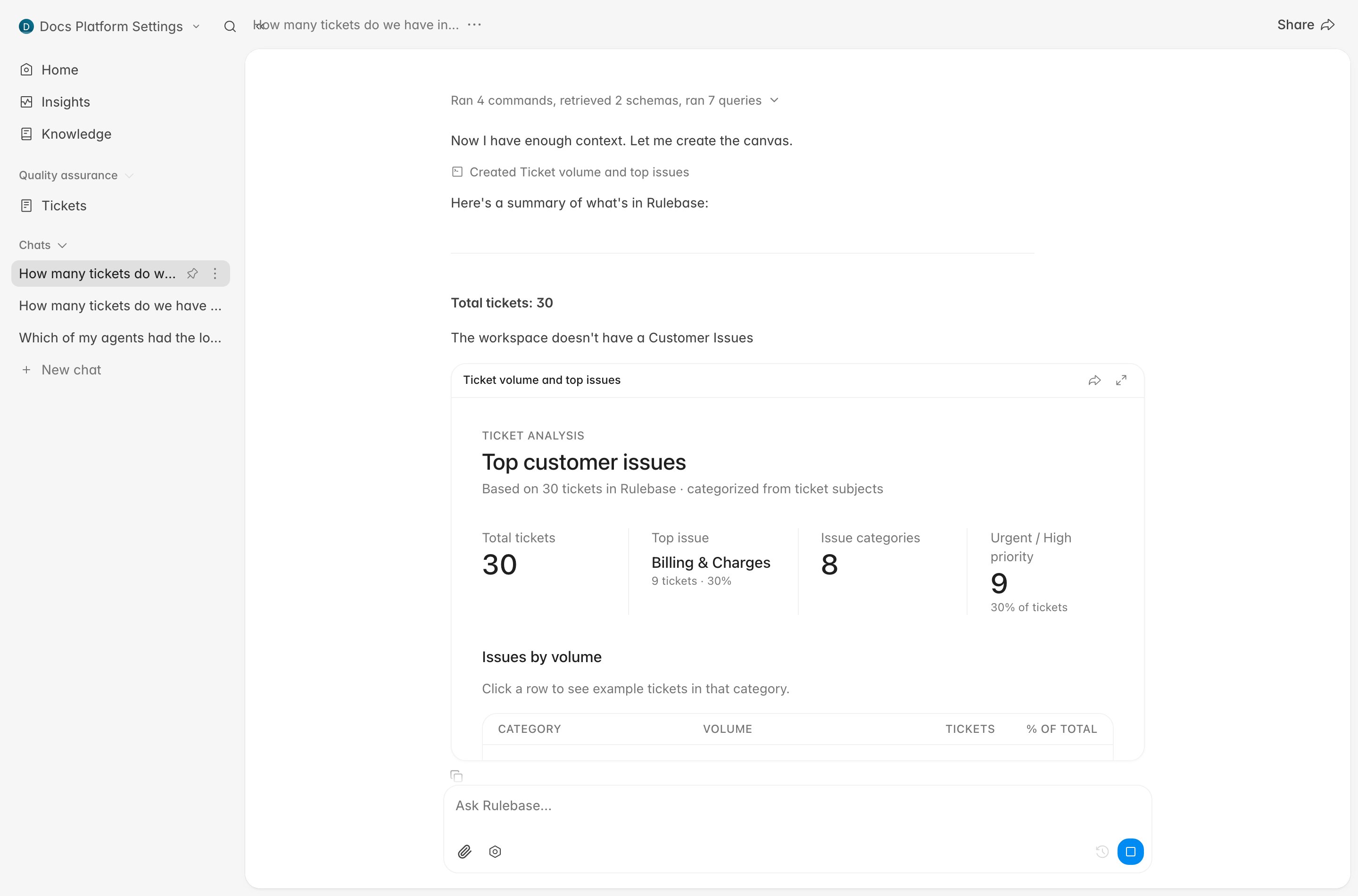 The icons in the card's corner copy a link to the canvas and open it larger;
canvases Instruct produced as files get a download icon too. Ask for a change
("group these by week", "add average handling time") and the canvas is rewritten
in place rather than repeated further down the chat.
Not everything arrives as a canvas. Instruct also writes to the product when you
ask it to: dashboards and the charts on them, sheets, documents saved into
Knowledge. Ask it to set up QA evaluations for a list of tickets, or attach a CSV
of ticket IDs, and it comes back with a confirmation card where you drop the rows
you did not want before anything is submitted; nothing is written on its own
initiative.
Ask for "an agent that emails us a weekly summary" and you will
usually get a **report** (a saved, scheduled summary) rather than an
agent. Recurring deliverables are what reports are for. Ask for something that
watches for events and acts on them and you get a managed agent instead. See
[Create a managed agent](/guides/agents/create-a-managed-agent) for that side of
it.
## Share the result
**Share** in the chat header copies a link to the whole conversation, canvases
included. The share icon on a canvas copies a link to just that canvas, on its
own page. Which one you want depends on whether the reasoning matters or only the
result does.
Both links need the recipient signed in to your Rulebase organization; neither
is a public URL. They do not need Instruct access of their own to read what you
send, so a link is a reasonable way to get an answer in front of someone whose
role does not include Instruct.
## Keep your chat list usable
Chats live under **Chats** in the sidebar: anything you have pinned, then your
five most recent. A chat is named after your opening message, which stops being
useful somewhere around the tenth one, so from the `...` menu on a chat you can
**Rename** it to something you will recognise next week or **Archive** it to take
it out of your history. The pin icon that appears on hover keeps the ones you
return to at the top.
## Related
* [Rulebase glossary](/guides/concepts/glossary)
* [Create a managed agent](/guides/agents/create-a-managed-agent)
* [MCP](/guides/mcp)
The icons in the card's corner copy a link to the canvas and open it larger;
canvases Instruct produced as files get a download icon too. Ask for a change
("group these by week", "add average handling time") and the canvas is rewritten
in place rather than repeated further down the chat.
Not everything arrives as a canvas. Instruct also writes to the product when you
ask it to: dashboards and the charts on them, sheets, documents saved into
Knowledge. Ask it to set up QA evaluations for a list of tickets, or attach a CSV
of ticket IDs, and it comes back with a confirmation card where you drop the rows
you did not want before anything is submitted; nothing is written on its own
initiative.
Ask for "an agent that emails us a weekly summary" and you will
usually get a **report** (a saved, scheduled summary) rather than an
agent. Recurring deliverables are what reports are for. Ask for something that
watches for events and acts on them and you get a managed agent instead. See
[Create a managed agent](/guides/agents/create-a-managed-agent) for that side of
it.
## Share the result
**Share** in the chat header copies a link to the whole conversation, canvases
included. The share icon on a canvas copies a link to just that canvas, on its
own page. Which one you want depends on whether the reasoning matters or only the
result does.
Both links need the recipient signed in to your Rulebase organization; neither
is a public URL. They do not need Instruct access of their own to read what you
send, so a link is a reasonable way to get an answer in front of someone whose
role does not include Instruct.
## Keep your chat list usable
Chats live under **Chats** in the sidebar: anything you have pinned, then your
five most recent. A chat is named after your opening message, which stops being
useful somewhere around the tenth one, so from the `...` menu on a chat you can
**Rename** it to something you will recognise next week or **Archive** it to take
it out of your history. The pin icon that appears on hover keeps the ones you
return to at the top.
## Related
* [Rulebase glossary](/guides/concepts/glossary)
* [Create a managed agent](/guides/agents/create-a-managed-agent)
* [MCP](/guides/mcp)