

Before you start
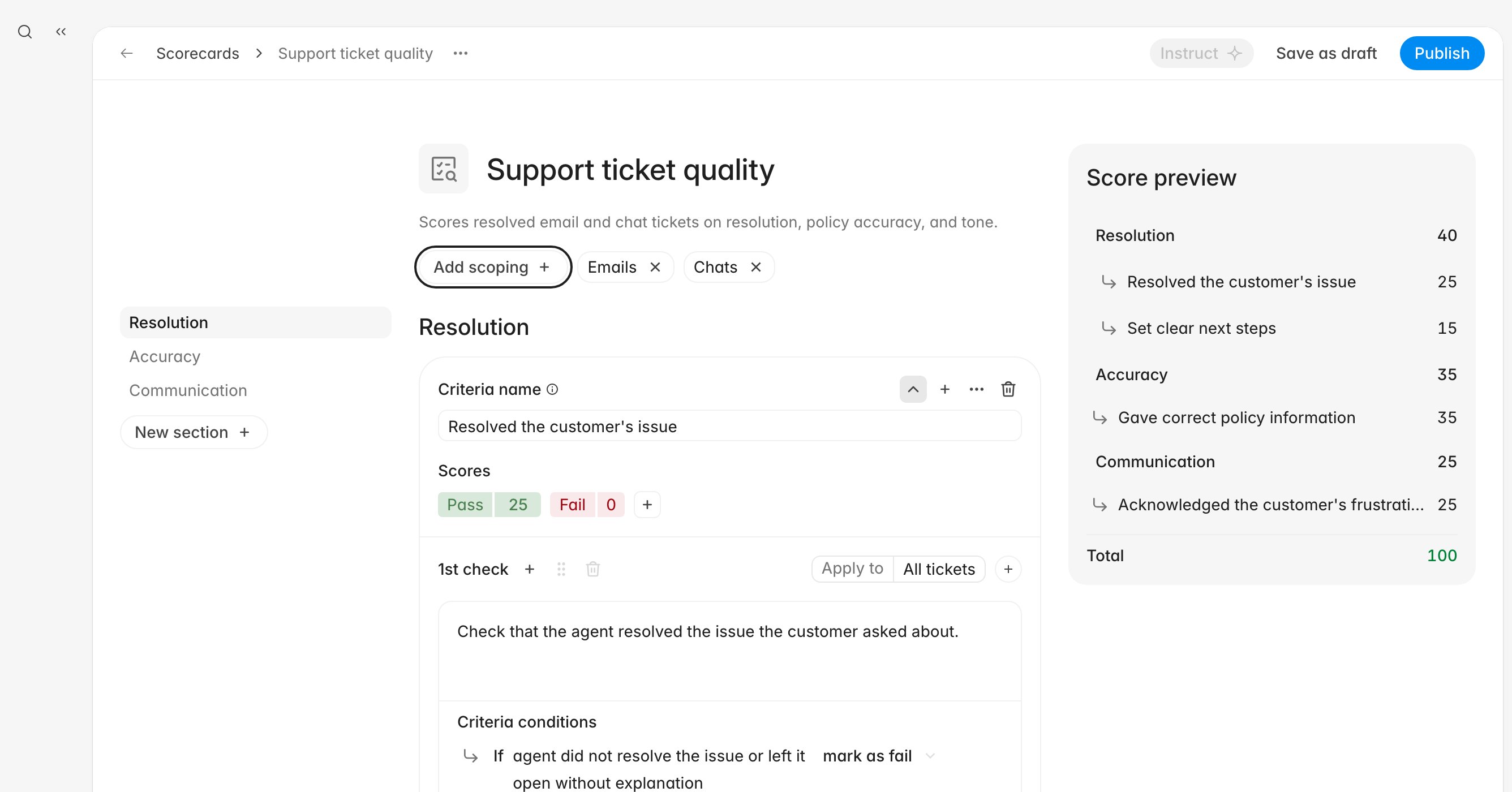
- Scorecards live under Knowledge > Scorecards.
- You need a role that can manage scorecards, such as
AdministratororManager. - Know whether the scorecard is Active or a Draft. A draft is invisible to AI QA and to reviewers, and safe to restructure freely. The next section is about the active case.
- New to the four levels (scorecard, section, criteria, check)? The glossary defines them, and Create a scorecard builds one from scratch.
Work on a copy of a live scorecard
Evaluations store the score a criterion was given, but read its wording live. Reword a check and the new sentence appears next to every past evaluation of that criterion. The numbers do not move, but a reviewer revisiting a disputed score sees text that was never applied to that ticket. Duplicating avoids this: the original keeps scoring, past evaluations keep their original wording, and you decide when the new version takes over.- Go to Knowledge > Scorecards.
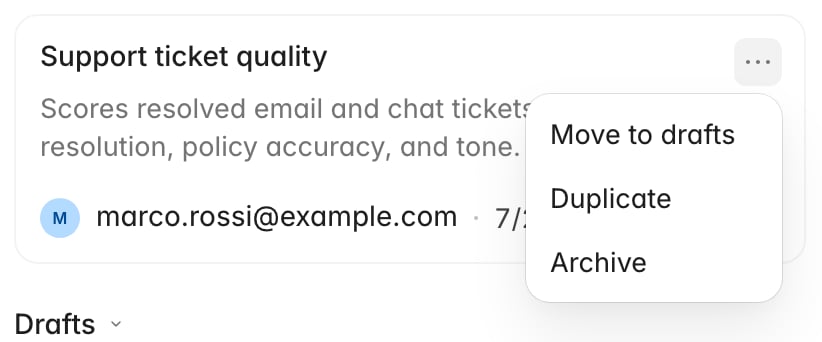
- Open the scorecard’s overflow menu and choose Duplicate.
- Rulebase opens a Duplicate scorecard dialog pre-filled with
<name> (copy)and the original description. Name it something a reviewer can tell apart, such asSupport ticket quality - Q3. - Click Create. The copy opens as a draft with every section, criterion, check, condition, and scoping pill carried over. The copied structure is not stored until you save it, so use Save as draft before closing the tab if you are not finishing in one sitting.
- Make your changes, then Publish the copy.
- Back on the list, use Move to drafts on the original so only one version is live.
Small in-place edits are fine when nothing about the judgement changes: fixing a
typo, tightening a sentence that means the same thing, or adjusting a scorecard
nobody has been evaluated against yet. Anything that changes what a criterion is
asking for belongs on a copy.
Reorder sections and criteria
Order affects presentation only, but it is the sequence reviewers read when they score by hand. Reorder in Score preview on the right. Rows in the section list stay fixed. Hover a row, and a drag handle appears on its left; drag it to its new position. Dragging a section row moves the whole section with its criteria.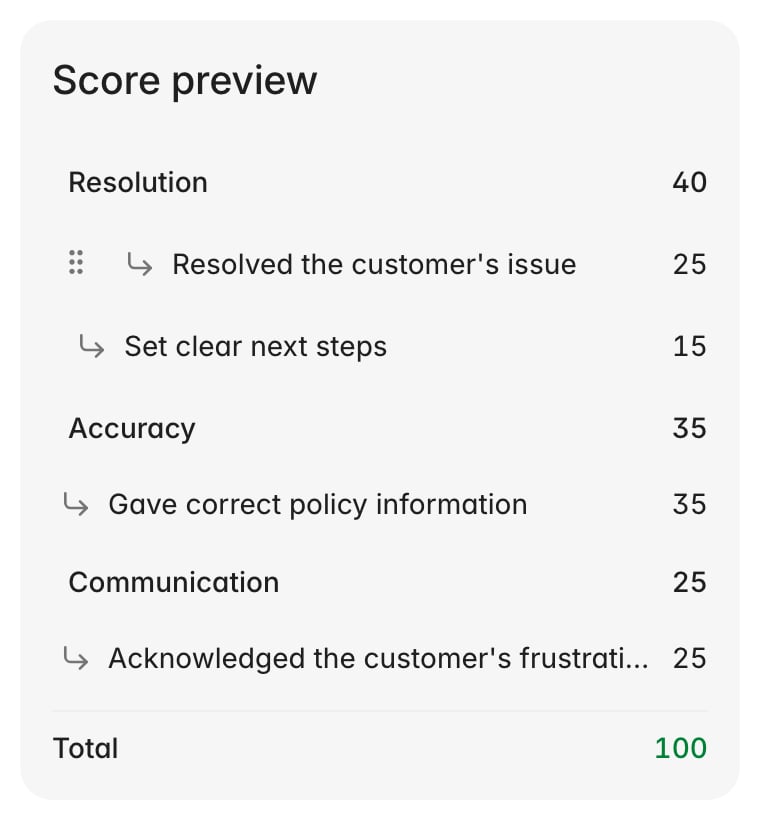
Resolution into
Accuracy. To move one across, recreate it in the target section and delete the
original. Deleting also removes its history of wording.
Checks reorder the same way, using the Drag to reorder handle on the check
row, inactive when a criterion has only one check.
Rename, edit, or remove a section
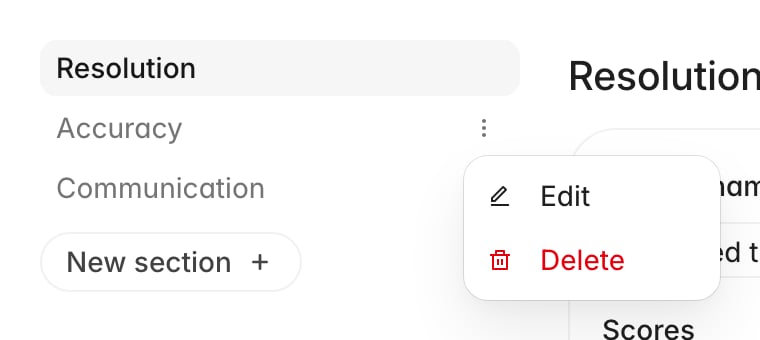
The section list on the left is where a section’s own details live.- Rename it inline. Double-click the section name, type, and press
Enter.Escapecancels. - Edit the name and instructions together. Hover the section, open its overflow menu, and choose Edit. Section instructions apply to every criterion underneath.
- Delete it. The same menu has Delete. It removes the section and every criterion inside it after you confirm, and their points leave the total. The option is hidden on the last remaining section.
Add and remove checks
Checks are the level you will touch most, because most rubric drift is a check that has stopped matching how your team judges tickets.- Open the section, then the criterion.
- Click Add new check at the bottom of the criterion card. Rulebase numbers
checks in order (
1st check,2nd check) and drops the cursor into the new description. - Write what the evaluator has to look for, then give the check at least one entry under Criteria conditions, using Generate conditions or Add condition manually.
- To remove a check, click the trash icon on its row.
Retarget what a check applies to
The Apply to pill decides whether a check runs on a ticket at all. It reads All tickets until you narrow it. Narrowing it is usually the fix when reviewers complain a check keeps failing on tickets it was never written for. Click the + next to the pill and pick a group: Channel, Ticket hierarchy, Ticket state, or SLA breaches. Each choice becomes its own pill, and the x on a pill removes that condition.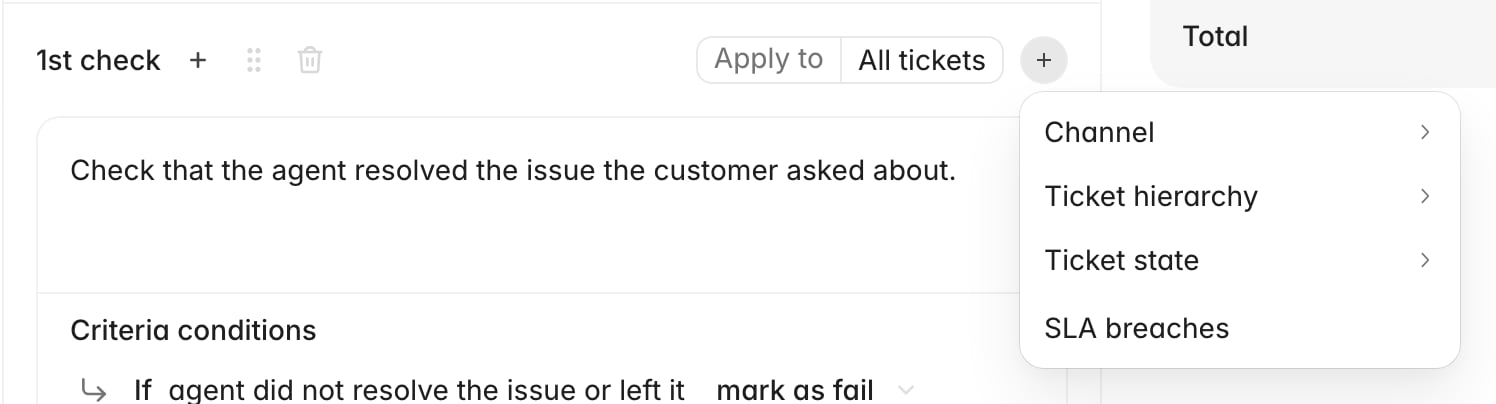
Rebalance the points
Points live on criteria, and the top-level total must come back to exactly 100 before Rulebase will publish. Score preview keeps the running total and turns red the moment you are off.- Change a criterion’s value. Click the number next to Pass, set it in
the Edit score popover, and press
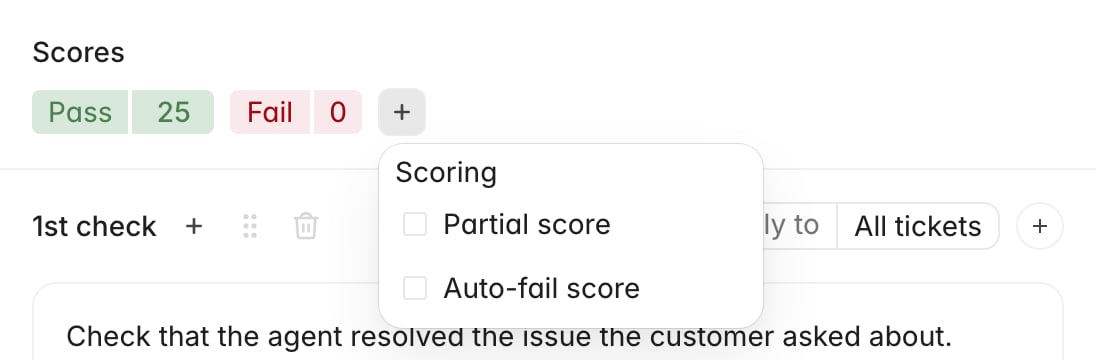
Enter. Section totals recalculate from their criteria. - Add partial credit. The + in the Scores row offers Partial score, which starts at 5 and is editable like Pass, as long as it stays below the criterion’s Pass value. A criterion can carry more than one partial option.
- Add an auto-fail. The same menu offers Auto-fail score: selecting it on one criterion zeroes the entire evaluation, taking down every other criterion’s points with it. One per criterion. Reserve it for a compliance breach that should void a ticket.
- Remove either of them. Partial and auto-fail options carry an x.
Pass and Fail do not, and
Failstays at 0.
If this criteria is not pass, cap overall score at N. It caps the whole scorecard’s total and leaves the points on other criteria
alone. Use it for a failure that should hold a ticket’s total down no matter how
well everything else went. One cap per criterion.
Publish, and what changes for whom
Publish validates first (the total, and a condition on every check), then makes the version live. From that moment, tickets that match the scorecard’s scope are evaluated against the new structure. Evaluations that already ran keep their scores; new evaluations use the new structure. To judge older tickets by the new rubric, re-evaluate them, because publishing does not reach backwards. Save as draft on a published scorecard keeps everything you have written and takes the scorecard out of evaluation. Use it when you started restructuring in place and would rather finish somewhere safer.Check before you publish
- Score preview reads 100, and the section weights match what was agreed.
- Every check still has at least one entry under Criteria conditions, including the ones you edited.
- The Apply to pills say what you meant. A check you narrowed to
Chatsstops running on email entirely. - If this is a duplicate, the original is under Drafts and only one version is Active. Two live scorecards covering the same tickets both evaluate.