Before you start
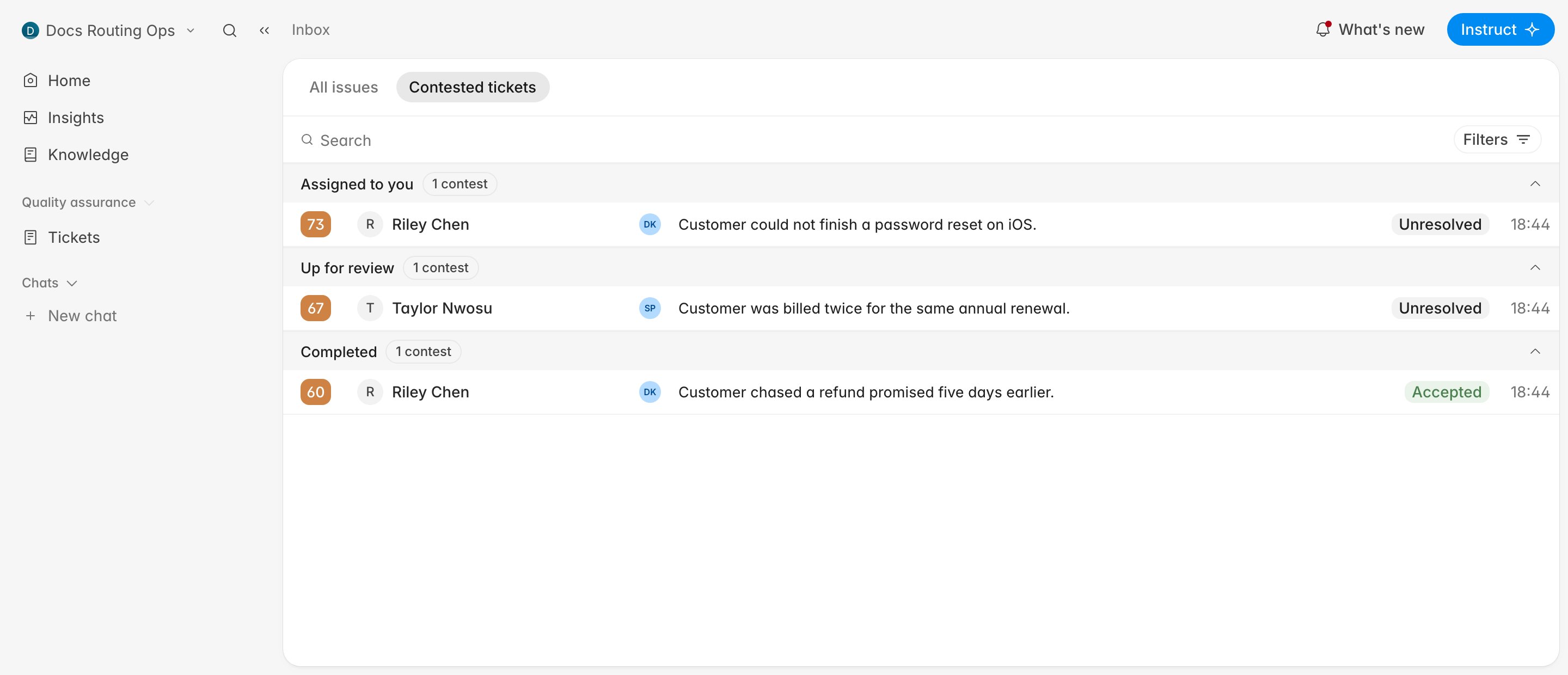
- Open Inbox > Contested tickets.
- Agents raise contests themselves, and only on an evaluation with at least one failed criterion. If your organization sets a dispute window under Settings > Evaluations, contests raised after that many days are refused.
- An agent can have only one open contest per ticket at a time, so you will not find two competing objections on the same evaluation.
Find the contest you should be working
The page groups contests by who is holding them:- Assigned to you — unresolved contests on tickets you are the assignee of. Start here.
- Up for review — unresolved contests assigned to someone else, or to nobody. Scan this when you are covering for a colleague or clearing a backlog.
- Completed — contests that have had a decision. The badge on the right reads Accepted or Rejected.
2nd level surfaces the disputes that have already been through one
decision.
Open the objection
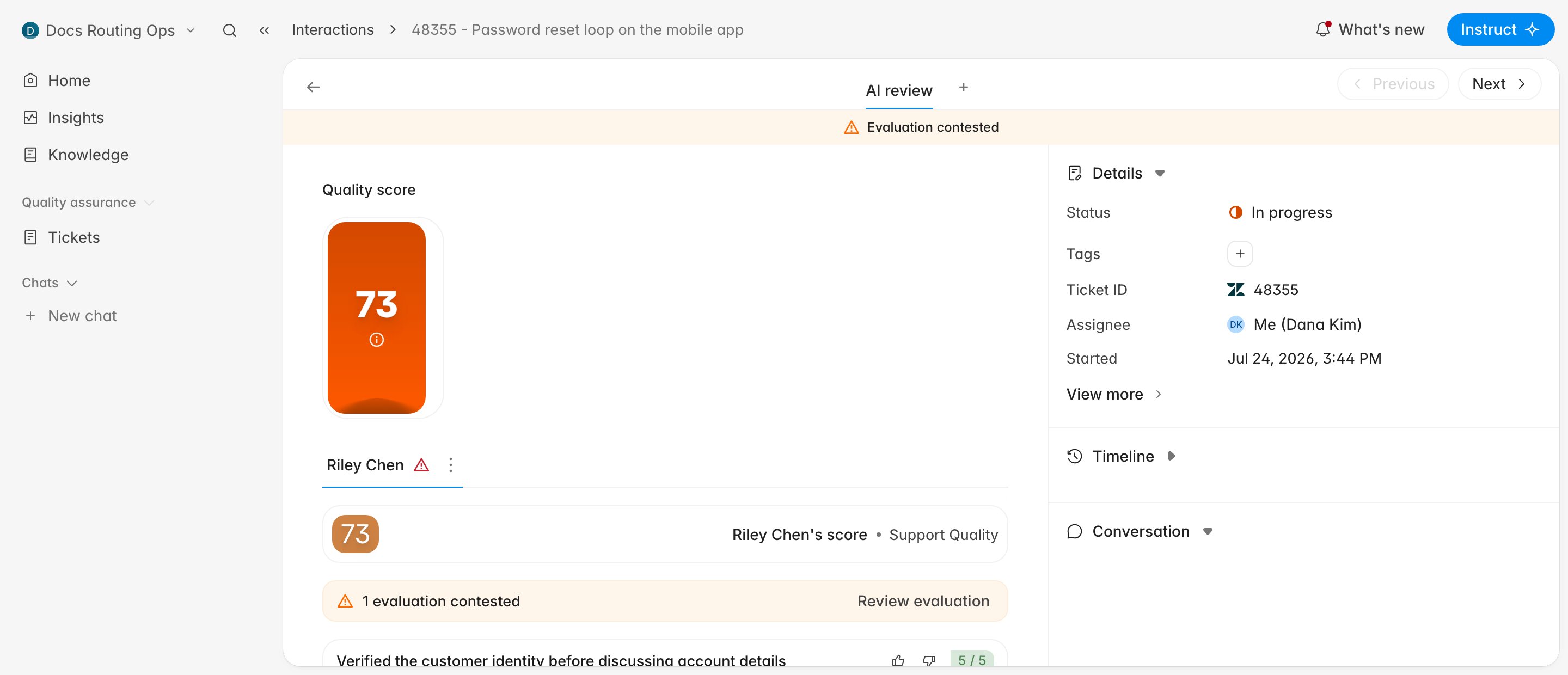
A contested ticket carries an Evaluation contested banner across the top, and the evaluation itself shows how many criteria are in dispute.- Click the contest in the inbox to open the ticket.
- Under the agent’s score, find the line counting the contested evaluations, such as 1 evaluation contested when a single criterion is in dispute.
- Click Review evaluation.
Read both sides before deciding
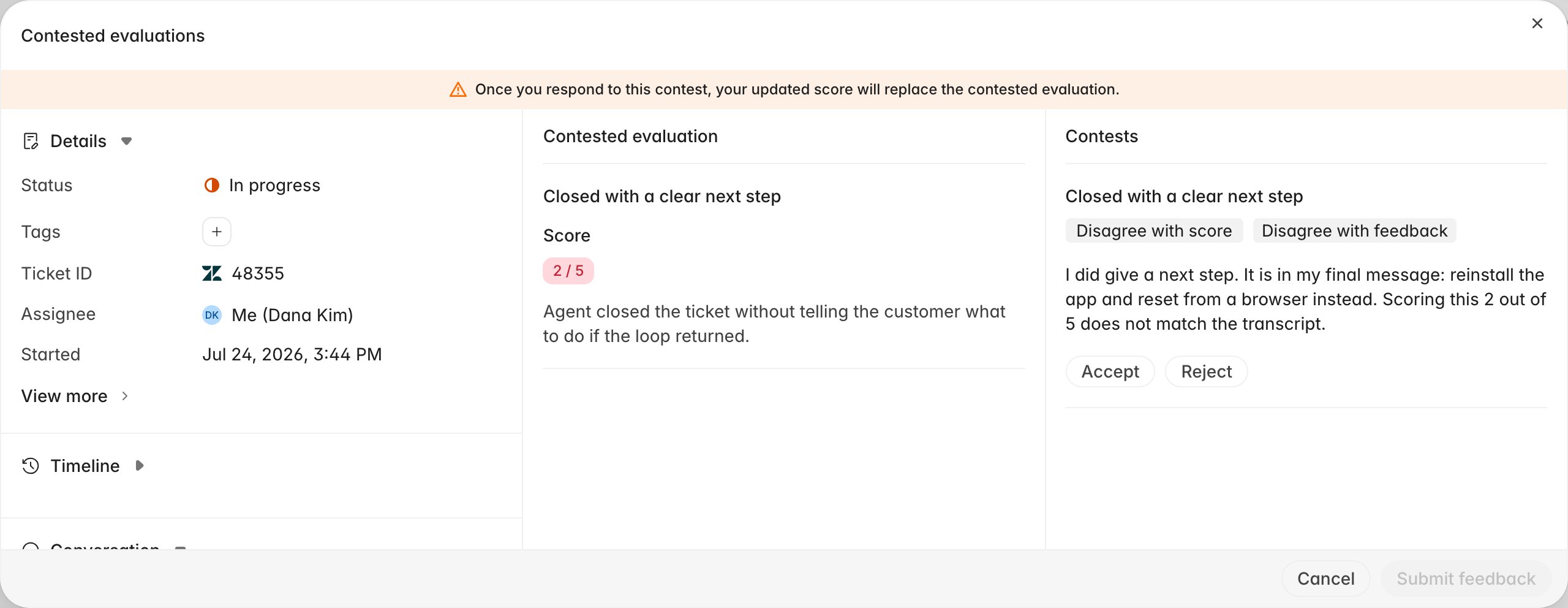
The Contested evaluations dialog puts the conversation, the original result, and the agent’s argument side by side, so the transcript is one pane away while you weigh the claim.- Left — ticket details and the conversation itself. This is where you verify the claim rather than take it at face value.
- Middle, Contested evaluation — the criterion as it was scored, its score out of the maximum, and the reason recorded at the time. Where the evaluation used checks, Check results expands to show each one.
- Right, Contests — what the agent is disputing. Disagree with score and Disagree with feedback are separate claims and a contest can carry both, followed by their comment and any files they attached.
Decide each criterion
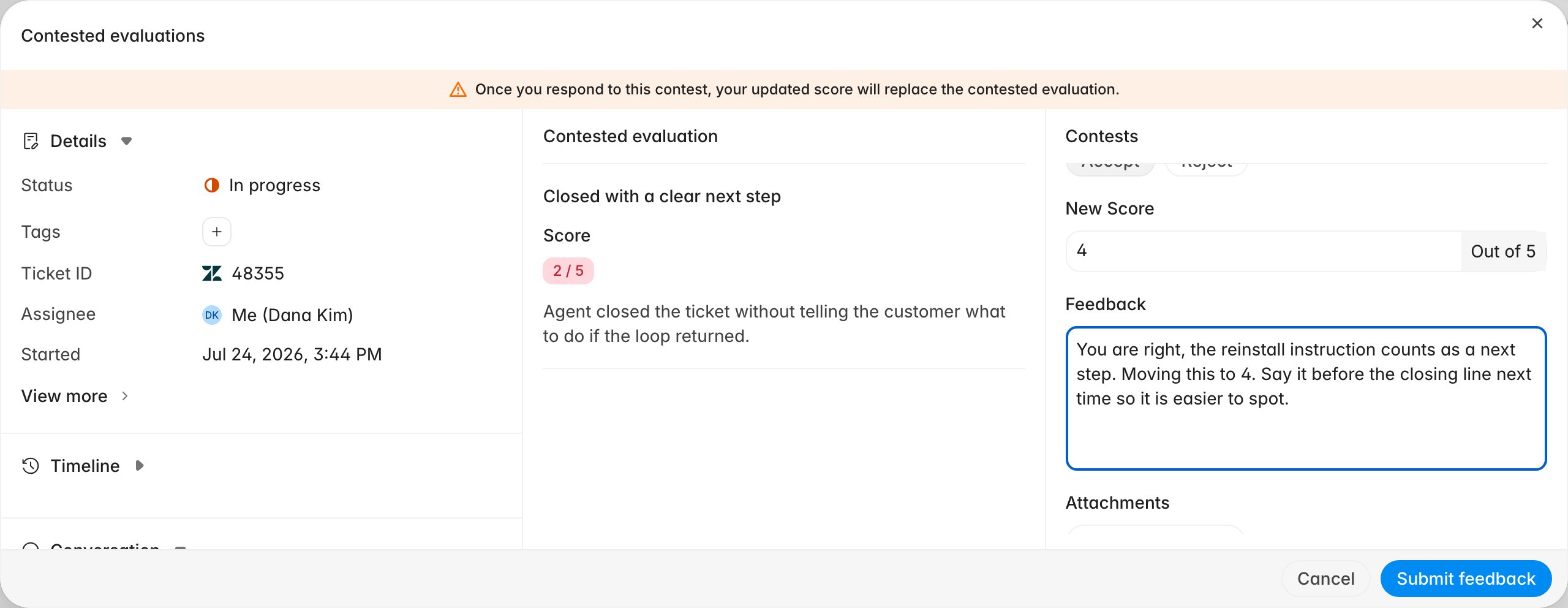
Every disputed criterion needs its own decision, and Submit feedback stays disabled until they all have one.- Click Accept or Reject on the criterion.
- If you accepted, set the New Score. A criterion built on score options gives you a dropdown, sometimes with a feedback option to pick alongside it. A criterion scored out of a maximum gives you a number field.
- Write the Feedback. It is required either way, and the agent reads it, so say what you looked at rather than just restating the outcome.
- Attach a file if the evidence is easier to show than describe.
- Click Submit feedback.